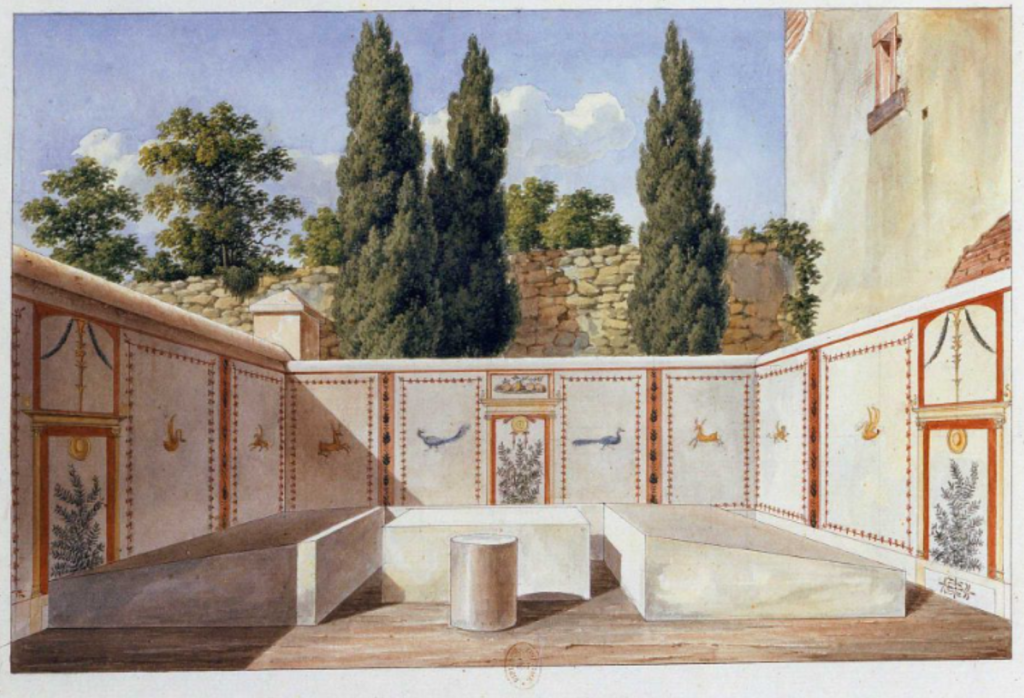
The Tomb of Cnaius Vibrius Saturninus is a rare occurance of a “triclinium tomb,” which utilized the traditional Roman domestic space of a triclinium, a three couched space where families/friends/guests could recline to enjoy their meals. At this time, it is the only triclinium tomb to be uncovered in Pompeii.
“Approaching the tomb on the Via dei Sepolcri, visitors would expect to have seen a stuccoed exterior and steps leading into a lavishly decorated triclinium space. Above the entrance was a pediment feature, and in its center was a dedicatory inscription for the deceased. It reads:
Cn(aeo) Vibrio
Q(uinti) f(ilio) Fal(erna)
Saturnino
Callistus lib(ertus)
[CIL X 1033]
For Cnaius Vibrius Saturninus, the son of Quintus, of the Falerna tribe. Callistus [his] freedman, [made it]. [Translation by author.]
From the inscription, there are several details about the tomb that we can discern. First, Cnaius was a man of some means in Pompeii, as he had the ability to own slaves and even free his slaves to (presumably) work for him. Second, the relationship between freedmen and former master was close in some extent, as his freedman Callistus is the one who “made the tomb” for Cnaius. Finally, like other tombs in this project, the creation by a freedman alludes to the social and economic opportunities given to freedmen of Pompeian society.
Entering the tomb, the visitor would have seen a grand frescoed dining space. In its current state, however, the frescos have been removed from Pompeii along with the triclinium feature and are no longer visible at the site. Unfortunately, the current time constraints of the project have left the current model unfinished in terms of the frescos, but it would have been a largely white background fresco, with birds, griffons, and lions surrounding a central frame. Although the image depicts the couches as white, it has also been argued that they would have been painted a red color, consistent with other triclinia found in Pompeii.